
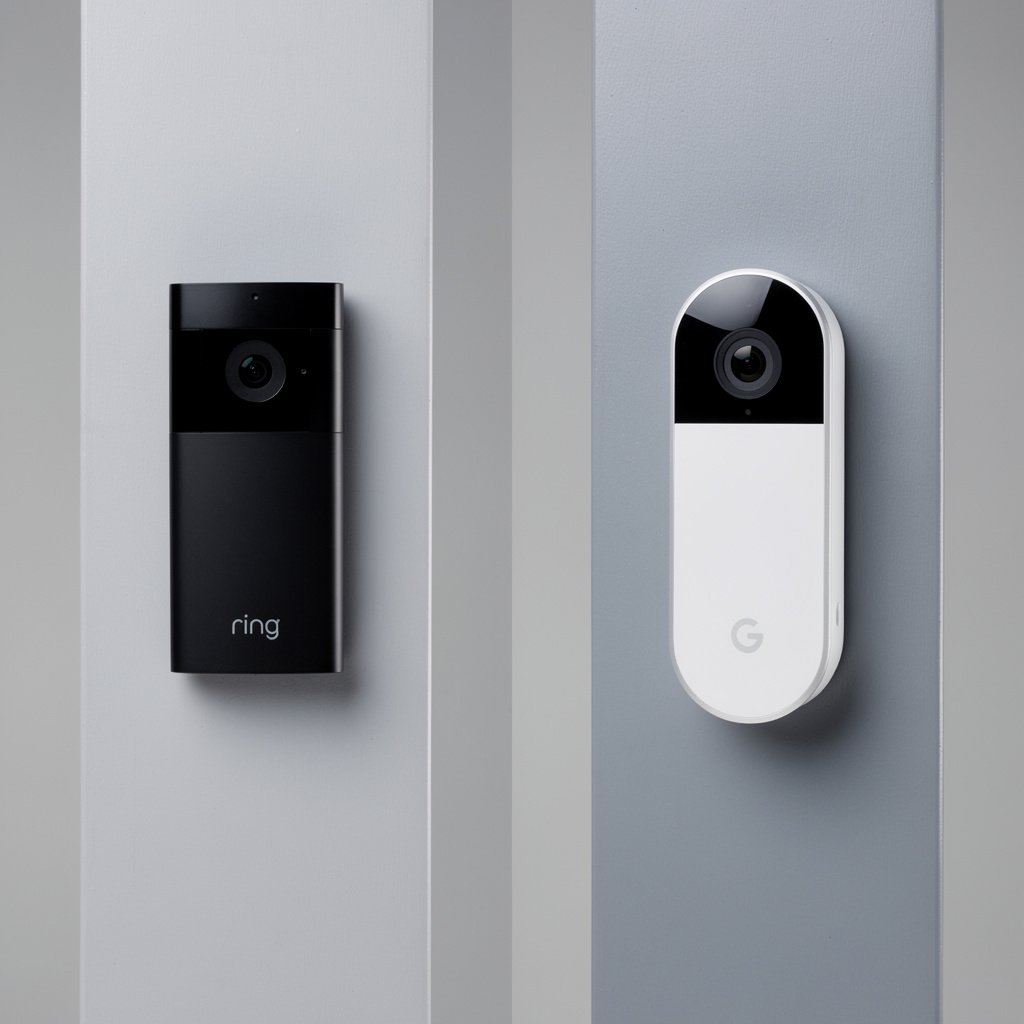
Ring and Google Nest dominate the video doorbell market, and for good reason. Both offer excellent video quality, smart features, and reliable performance. But which one is right for your home? After extensive testing of the Ring Video Doorbell Pro 2 and Google Nest Doorbell (wired and battery), we've broken down every difference to help you choose.
The short answer: Ring is better for Alexa households and those wanting professional monitoring. Nest is better for Google Home users and those wanting superior AI detection. Let's dive into the details.
Quick Comparison: Ring vs Nest Doorbell
| Feature | Ring Video Doorbell Pro 2 | Google Nest Doorbell (Wired) |
|---|---|---|
| Price | $249 | $179 |
| Resolution | 1536p HD+ (Head to Toe) | 960×1280 HDR |
| Field of View | 150° horizontal, head-to-toe | 145° diagonal |
| Power | Hardwired only | Hardwired (battery version available) |
| 3D Motion Detection | Yes (radar) | No |
| Package Detection | Yes (subscription) | Yes (free) |
| Facial Recognition | No | Yes (subscription) |
| Local Storage | No | Up to 3 hours free |
| Subscription Cost | $4/mo or $100/yr | $6/mo or $60/yr |
| Smart Assistant | Alexa (native) | Google Assistant (native) |
| Professional Monitoring | Yes ($20/mo) | No |
| Best For | Alexa users, security-focused | Google users, AI detection |
Video Quality Comparison
Ring Video Doorbell Pro 2
Ring's Pro 2 offers the sharpest image with 1536p resolution—50% more pixels than standard 1080p. The “Head to Toe” aspect ratio captures visitors from head to feet, eliminating the need to awkwardly angle your doorbell. At night, Ring's color night vision performs well in moderately lit areas, though it switches to black and white in complete darkness.
Standout feature: 3D Motion Detection uses radar technology to precisely track motion in your customized zones, reducing false alerts from cars passing by or trees swaying.
Google Nest Doorbell
Nest's 960×1280 resolution sounds lower on paper, but the HDR processing often produces more balanced footage, especially in challenging lighting like bright sunlight or shaded porches. The image handles high-contrast situations (bright sky, dark porch) better than Ring in our testing.
Standout feature: HDR processing means faces are clearer even when the sun is behind visitors—a common problem for doorbell cameras.
Winner: Ring for raw resolution and night vision. Nest for HDR processing in mixed lighting.
AI Detection and Alerts
This is where the two diverge significantly.
Ring Detection
- Motion Zones: Customizable zones to ignore areas like sidewalks
- 3D Motion Detection: Radar-based tracking (Pro 2 only)
- Person Detection: Distinguishes people from other motion
- Package Detection: Alerts when packages arrive or are removed (Ring Protect required)
- Smart Alerts: Reduce notification frequency for familiar motion patterns
Ring's detection is reliable but basic. It tells you that something happened, but not always what happened.
Nest Detection
- Person Detection: Free, identifies humans vs. animals vs. vehicles
- Package Detection: Free, no subscription required
- Facial Recognition: Identifies familiar faces by name (Nest Aware required)
- Vehicle Detection: Distinguishes cars from people
- Animal Detection: Identifies pets and wildlife
- Activity Zones: Customizable detection areas
Nest's AI is genuinely impressive. Notifications say “Person detected” or “Package delivered” instead of generic “Motion detected” alerts. Facial recognition learns your family members and announces them by name on Nest speakers.
Winner: Nest, decisively. The AI detection is a generation ahead, and package/person detection is free.
Installation Comparison
Ring Pro 2 Installation
The Pro 2 requires hardwired installation with 16-24 VAC doorbell transformer. The included Pro Power Kit v2 ensures sufficient power. Installation is straightforward if you have existing doorbell wiring—about 15-30 minutes. If you don't have wiring, you'll need an electrician or the battery-powered Ring Video Doorbell 4 instead.
Nest Doorbell Installation
The wired Nest Doorbell installs similarly to Ring, using existing doorbell wiring. Google also offers a battery-powered version that requires no wiring at all—just mount with the included screws or optional wedge.
Battery version advantage: If your wiring is inadequate or you're renting, Nest's battery doorbell is the easier solution.
Winner: Nest for flexibility (battery option). Tie for wired installation difficulty.
Smart Home Integration
Ring + Alexa
Ring is owned by Amazon, so Alexa integration is exceptional:
- “Alexa, show me the front door” displays live feed on Echo Show
- Doorbell announcements on all Echo devices
- Two-way talk through Echo Show
- Motion-triggered routines (turn on lights when motion detected)
- Integration with Ring Alarm security system
- Works with Ring Chime Pro for extended WiFi and indoor alerts
Ring also works with Google Home and HomeKit (through third-party workarounds), but the experience is limited compared to native Alexa support.
Nest + Google Assistant
Nest integrates seamlessly with Google's ecosystem:
- “Hey Google, show me the front door” on Nest Hub/TV
- Doorbell announcements on all Google speakers and displays
- Facial recognition announcements: “John is at the front door”
- Two-way talk through Nest Hub
- Integration with Nest cameras and Nest Protect
- Works with Google Home automations
Nest does not work with Amazon Alexa or Apple HomeKit.
Winner: Depends on your ecosystem. Ring wins for Alexa homes. Nest wins for Google homes. Neither crosses ecosystems gracefully.
Subscription Plans Compared
| Plan | Ring Protect Basic | Ring Protect Plus | Nest Aware | Nest Aware Plus |
|---|---|---|---|---|
| Cost | $4/mo or $40/yr | $10/mo or $100/yr | $6/mo or $60/yr | $12/mo or $120/yr |
| Video History | 180 days | 180 days | 30 days | 60 days |
| Devices Covered | 1 device | Unlimited devices | All devices | All devices |
| 24/7 Recording | No | No | No | Yes (wired cameras) |
| Facial Recognition | No | No | Yes | Yes |
| Package Detection | Yes | Yes | Free (no sub) | Free (no sub) |
| Pro Monitoring | No | $20/mo add-on | No | No |
Key differences:
- Ring offers longer video history (180 days vs. 60 days max)
- Nest includes package detection free; Ring requires subscription
- Nest offers facial recognition; Ring does not
- Ring offers professional monitoring; Nest does not
- Nest includes 3 hours of free event history without any subscription
Winner: Nest for value (more free features). Ring for video retention and professional monitoring options.
Privacy and Security
Ring Privacy
Ring has faced criticism for data sharing practices and police partnerships. However, they've improved significantly:
- End-to-end encryption available (opt-in)
- Two-factor authentication required
- Police requests now require user consent
- Neighbors app sharing is optional
Nest Privacy
Google processes video through their cloud for AI features. Privacy considerations:
- Video stored in Google Cloud (no end-to-end encryption option)
- Facial recognition data stored in cloud
- Two-factor authentication available
- Activity data used for Google Home improvements (can opt out)
Winner: Ring for privacy options (end-to-end encryption available). Neither is perfect.
Build Quality and Reliability
Both devices are built to withstand weather, but there are differences:
Ring Pro 2:
- Operating temperature: -5°F to 120°F
- Weather-resistant (not waterproof)
- Larger, more prominent design
- Interchangeable faceplates available
Nest Doorbell:
- Operating temperature: -4°F to 104°F
- IP54 water-resistant
- Sleeker, more compact design
- Battery version includes local storage backup
Winner: Ring for extreme temperature tolerance. Nest for aesthetics.
Which Should You Buy?
Choose Ring Video Doorbell Pro 2 If:
- You're in the Amazon/Alexa ecosystem
- You want professional security monitoring
- You prioritize video resolution (1536p)
- You need 3D motion detection to reduce false alerts
- You want longer video history (180 days)
- You prefer end-to-end encryption option
- You have a Ring Alarm system
Choose Google Nest Doorbell If:
- You're in the Google Home ecosystem
- You want superior AI detection (faces, packages, vehicles)
- You want more free features without subscription
- You need a battery-powered option (no wiring)
- You want facial recognition with name announcements
- You prefer a sleeker, more compact design
- You're on a tighter budget ($179 vs. $249)
Final Verdict
Both are excellent video doorbells that will serve you well for years. The decision ultimately comes down to your smart home ecosystem.
For Alexa households: The Ring Video Doorbell Pro 2 ($249) offers the best integration, highest resolution, and professional monitoring options. If budget is a concern, the Ring Video Doorbell 4 ($199) offers similar features with battery power.
For Google households: The Google Nest Doorbell (wired $179, battery $179) provides smarter AI detection, more free features, and seamless Google Assistant integration. The facial recognition alone is worth the switch for many families.
For mixed/neutral households: The Nest Doorbell offers better value with more free features and superior AI. You'll sacrifice some Alexa integration, but the smarter notifications make daily use more pleasant.
The best doorbell is the one that works seamlessly with the smart home you already have. Choose Ring for Alexa, Nest for Google, and you won't be disappointed.
Frequently Asked Questions
Can Ring work with Google Home?
Limited integration exists through third-party services, but you won't get live video on Nest displays or full smart home integration. For the best experience, pair Ring with Alexa.
Can Nest Doorbell work with Alexa?
No. Google Nest devices do not work with Amazon Alexa. You'll need to use Google Home or Google Assistant for voice control.
Do I need a subscription for basic use?
Both work without subscriptions for live view and basic alerts. Nest offers more free features (package detection, 3 hours of history). Ring requires subscription for video history and package detection.
Which has better night vision?
Ring Pro 2 has color night vision that works well in moderately lit areas. Both switch to infrared black-and-white in complete darkness. Ring's night vision is slightly better in our testing.
Can I install these myself?
Yes, if you have existing doorbell wiring. Both include all necessary hardware and have excellent app-guided installation. The Nest battery version requires no wiring at all.