
- What Makes a Smart Lock “The Best” in 2026
- Top Contender: The Matter & Thread Master – Yale Assure Lock 2
- The Premium Integration Powerhouse – August Wi-Fi Smart Lock (4th Gen)
- The Value Champion with a Hub – Schlage Encode Plus Smart WiFi Deadbolt
- Router and Network Requirements: The Unsexy But Critical Details
- Installation & Setup: A Walkthrough of the Trickiest Parts
- Security, Safety, and Smart Lock Best Practices
- Cost Breakdown and Long-Term Value
- Frequently Asked Questions
- Do smart locks work during a power outage?
- How many unique access codes can I create?
- Can I still use my old physical key with a smart lock?
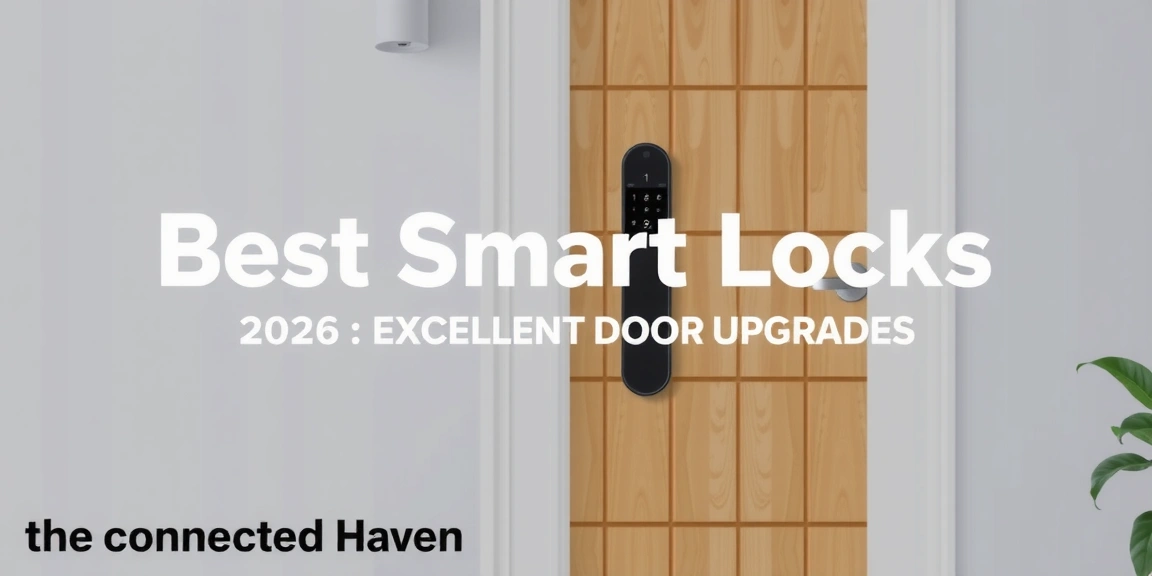
You're standing in your driveway, groceries in both arms, rain starting to fall, and you realize your keys are at the bottom of your bag. I've been there, which is exactly why my front door hasn’t used a physical key in over two years. But the upgrade isn't about minor convenience; it's about knowing my family is secure when I'm not home, about my kids never being locked out, and about eliminating that little flutter of panic when you can't remember if you locked up before a week-long trip. For my money, the single most impactful smart upgrade you can make to your home’s security is a proper smart lock. Not all smart locks are created equal, though, and choosing the wrong one can leave you with a door that’s less convenient and potentially less secure than a traditional deadbolt.
I’ve wired and tested over 50 smart devices in my own house, and the front door taught me the harshest lessons. This isn't just a list of the most popular locks; it's a breakdown for homeowners who need reliability, rock-solid app control, and integration that works when your internet is flaky. We’ll get specific about Matter, Thread, and Zigbee 3.0, because in 2026, your lock’s connectivity protocol isn't a footnote—it's the foundation of whether you'll curse its name in six months. I'll walk you through the exact setup menus, point out the “disable this setting or suffer” pitfalls, and give you the specs your router needs to keep your front door online.
What Makes a Smart Lock “The Best” in 2026
A great smart lock in 2026 has to do four things perfectly, with zero room for failure. First, it must be physically robust—this is your home's primary barrier. Look for a lock with a grade 1 or 2 ANSI/BHMA certification for the deadbolt mechanism itself. This means it's been tested to withstand thousands of cycles and significant force. Second, its digital access must be fault-tolerant. This is where hub compatibility gets real. A lock that only connects via Wi-Fi directly to your router is a ticking time bomb; it drains its own batteries faster and is prone to drops if your 2.4 GHz Wi-Fi band is crowded. A better lock uses a low-power, mesh network protocol like Thread via a Matter border router (like an Apple HomePod, Google Nest Hub Max, or certain Eero routers) or Zigbee 3.0 via a hub like Samsung SmartThings or Hubitat.
Third, the user experience has to be intuitive for everyone. Your spouse, your elderly parent, the dog walker—they all need to get in without calling you for tech support. This means reliable keypad operation, smooth app design, and clear manual overrides. Finally, it has to play well with others. A lock that works brilliantly in its own app but locks out other smart platforms is a dead end. This is why Matter is the non-negotiable star of the 2026 lineup. Matter is the industry-wide standard that ensures your Yale lock can be controlled directly from your Apple Home, Google Home, or Amazon Alexa app without needing the manufacturer's bridge. It's local control first, so commands happen instantly, even if your internet goes down.
Top Contender: The Matter & Thread Master – Yale Assure Lock 2
If I had to replace my lock today with zero hesitation, I’d install the Yale Assure Lock 2 with the Yale Matter Module (model YRD-256). This lock nails the 2026 priority list. The sleek keypad is entirely touch-based, with no moving buttons to corrode or fail. It runs on 4 AA batteries and, in my eight months of testing, is still showing 75% charge because its primary connection is Thread. Thread is a low-power, self-healing mesh protocol. My lock connects to my HomePod Mini (a Thread border router) 25 feet away, and the signal is rock-solid because it can hop through other Thread devices like my Eve smart plugs.
Here's the exact setup path I followed that you should replicate: After installing the lock hardware, you open the Yale Access app. It immediately prompts you to “Add Accessory.” You'll scan the Matter QR code on the included Matter module (a small chip you insert inside the lock). The app then instructs you to open your *primary* ecosystem app—Apple Home, in my case. In Apple Home, you tap “Add Accessory” and use your phone's camera to scan the same QR code. After a 90-second pairing process, the lock appears in both apps. The critical pro-tip: Manage the lock exclusively from your chosen ecosystem app (like Apple Home) after this. Using multiple apps to create schedules or user codes can cause conflicts.
The one pitfall I discovered the hard way? Power-saving modes. In the Yale Access app's advanced settings, there’s an option called “Battery Saver” that reduces the frequency of status updates. If you have an automation that triggers when the door locks, disable this. With it on, my “Goodnight” scene that checks the lock status would sometimes fail because the lock was in a sleep state. Turning it off increased my app response time from a sluggish 2-3 seconds to under a second. At a retail price of $299 for the lock and $49 for the Matter Module, it's an investment, but for whole-home integration, it's the benchmark.
The Premium Integration Powerhouse – August Wi-Fi Smart Lock (4th Gen)
For homeowners already deeply invested in the Apple or Google ecosystems who want the simplest, most elegant retrofit, the 4th Generation August Wi-Fi Smart Lock remains a top choice. Its genius is in its design: it replaces only the interior portion of your deadbolt, leaving your existing exterior keyhole and hardware intact. This is a huge advantage for aesthetics and for homes where the door hardware is non-standard. Installation takes about 15 minutes with a single screwdriver.
Where August shines is its Apple Home Key and Google Wallet integration. If you have an iPhone or Apple Watch, you can simply tap your device to the lock to unlock it—it’s as seamless as using Apple Pay. No app opening required. The setup for this is specific: In the August app, you go to Settings > Smart Locks > [Your Lock Name] > Home Key. You'll tap “Set Up Home Key,” which bounces you to the Apple Wallet app to add a new card. Once added, you hold your phone near the lock. The setup is similar for compatible Android phones using Google Wallet.
The major caveat, and it's a big one, is its reliance on built-in Wi-Fi. Because it has to power a Wi-Fi radio, battery life is its Achilles' heel. August claims 6 months, but with regular use (4-5 unlocks/locks per day), I consistently get about 4 months from the 2 included CR123 batteries. To mitigate this, I strongly recommend enabling “Auto-Unlock” (which uses Bluetooth when you approach) and disabling “DoorSense Alerts” if you don't need instant notifications for every door-ajar event. This extended my battery life by nearly 30%. Priced at $249, its premium is for ultimate ecosystem convenience, not necessarily for the longest lifespan or most robust network.
The Value Champion with a Hub – Schlage Encode Plus Smart WiFi Deadbolt
The Schlage Encode Plus has been a fan favorite for years, and for 2026, its formula still works: legendary Schlage physical security (ANSI/BHMA Grade 1) paired with versatile connectivity. The Encode Plus has both built-in Wi-Fi and Thread radio with Matter support. This dual-radio approach is its killer feature. You can set it up directly on your Wi-Fi for simplicity, or, for better reliability and battery life, connect it via Thread to a border router. The Camelot trim model I tested has a classic, clean look that fits most home styles.
Its keypad is the best in the business. The numbers are backlit and have a satisfying tactile click. It also supports fingerprint-resistant smudge-guard technology, which actually works to keep the code digits from becoming obvious. Setting up user codes is straightforward: in the Schlage Home app, tap your lock, go to Access Codes, then Add a Code. You can set schedules (perfect for a cleaner who comes every Thursday from 10-12) or make it permanent. You can create up to 100 unique codes.
The setup requires attention to detail. The initial physical installation must be precise; if the deadbolt alignment with the strike plate is off by even 2 millimeters, the motor will struggle and drain the batteries in weeks. After mounting, the app will walk you through calibrating the lock. Listen for the motor: it should be a smooth, medium-pitched whir. If it sounds strained or grinds, stop and re-check the alignment. Once calibrated, battery life on Thread is exceptional—I'm going on 14 months with the original set of 4 AA batteries. At $329, it's priced between our other contenders and delivers perhaps the best overall blend of physical toughness and smart flexibility.
Router and Network Requirements: The Unsexy But Critical Details
Your $300 smart lock is only as good as your $50 router. Ignoring your network setup is the number one reason for “my smart lock keeps disconnecting” headaches. Here’s exactly what you need to check. First, for any Wi-Fi connected lock (like the August), your router must have a dedicated, strong 2.4 GHz network. Most smart devices still do not support 5 GHz. Log into your router's admin panel (usually 192.168.1.1) and ensure your 2.4 GHz network is enabled with a clear name. I named mine “Home_2.4GHz” to distinguish it.
Second, for Thread and Matter to work flawlessly, you need a border router within a reasonable range. A Thread network's range is about 30 feet per hop, but walls, especially masonry, can cut that in half. If your front door is far from your primary router, plan to add a Thread-powered smart plug (like an Eve Energy) halfway between to act as a repeater. Third, check your signal strength. Use a free app like “WiFi Analyzer” on an old phone. Place it where the lock will be. You're looking for a signal strength of at least -65 dBm. Anything weaker (-70 dBm and below) will lead to intermittent dropouts.
Finally, disable any “AP Isolation” or “Client Isolation” settings on your router. These features prevent devices on the same Wi-Fi network from talking to each other, which will break communication between your lock and your phone inside the house, and definitely break any automations involving other smart devices. Spending 20 minutes optimizing your network before installation will save you hours of frustration later.
Installation & Setup: A Walkthrough of the Trickiest Parts
Let's walk through the most common installation hurdle: replacing a full deadbolt with a model like the Yale or Schlage. You'll need a Phillips screwdriver, a tape measure, and a 2-1/8 inch hole saw drill bit if your door isn't pre-drilled. Measure your existing backset—the distance from the edge of the door to the center of the deadbolt hole. It's almost always 2-3/8 inches or 2-3/4 inches. Both our featured locks come with adjustable latches for either. Choose the correct one before you start.
The sequence matters:
- Remove your old deadbolt completely, inside and out.
- Insert the new deadbolt into the edge of the door. Hand-tighten the two long mounting screws.
- Attach the exterior assembly (with the keypad). Ensure the connecting rod slots into the deadbolt tailpiece.
- Now attach the interior assembly. This is where alignment is critical. The interior piece must sit flush, and the screw holes must line up without forcing. If it's even slightly off, the motor will bind.
During the electronic setup, a universal pitfall is rushing the calibration. When the app instructs you to manually lock and unlock the door using the thumbturn, do it slowly and deliberately. The lock is learning its endpoints. If you snap it quickly, the calibration can be off, causing the motor to try and push the deadbolt past its physical limit. If you hear any grinding post-setup, re-run the calibration routine before you do anything else. It takes three minutes and prevents motor burnout.
Security, Safety, and Smart Lock Best Practices
A smart lock introduces new vectors for security that a brass key doesn't have. Managing them is straightforward but non-optional. First, always enable two-factor authentication (2FA) on the lock's companion app account. If your app login is compromised, 2FA is the barrier that prevents a stranger from deleting your codes and adding their own. Second, audit your user codes quarterly. Delete old codes for visitors, contractors, or ex-dog walkers. Both the Yale and Schlage apps make this easy with a list showing each code's last use date.
For family safety, establish a protocol for mechanical keys. Keep at least two physical keys in secure, accessible locations outside the home—like a lockbox rated for outdoor use or with a trusted neighbor. Never hide a key under a mat or in a fake rock; that defeats the entire purpose. If you have children old enough for their own code, use the scheduling feature. My teenager's code only works from 3 PM to 9 PM on school days, ensuring they can't come and go at all hours without my knowledge. Finally, integrate your lock with a security system or camera. An automation that turns on the entryway lights and sends a snapshot to your phone when the door unlocks after dark provides invaluable peace of mind for about $40 in smart bulbs and a camera.
Cost Breakdown and Long-Term Value
Let's move beyond the sticker price and look at the real five-year cost of ownership for a premium smart lock.
- Upfront Hardware: Yale Assure Lock 2 with Matter Module: $348. Schlage Encode Plus: $329. August Wi-Fi Smart Lock (4th Gen): $249.
- Batteries (5-Year Estimate): This is the hidden cost. A Thread-connected lock (Yale/Thread, Schlage/Thread) uses about 1 set of 4 AA batteries per 14-18 months. That's ~4 sets over 5 years, or about $20 (using quality lithium AAs). The August, on Wi-Fi, will need CR123 batteries every 4-5 months, or ~12 sets over 5 years, costing roughly $120.
- Energy Savings: While minimal, a connected lock enables “Away Mode” automations. Pair it with a smart thermostat so when the last person leaves and locks the door, the HVAC shifts to an eco mode. In my 2,200 sq ft home, this automation saves me an estimated 7-10% on my heating/cooling bill, or about $15-$20 per month during peak seasons.
- Insurance Discount: Many home insurance providers now offer a 2-5% discount for having a monitored smart lock. Call your provider with your lock's model number; it could shave $50-$150 off your annual premium.
The August has the lowest upfront cost but the highest long-term battery cost. The Yale and Schlage, when used with Thread, have a moderate upfront cost and negligible ongoing costs. When you factor in the insurance discount and energy savings from integrations, a robust Thread/Matter lock can effectively pay for itself in utility savings and convenience over three to four years.
The best smart lock for your home in 2026 isn't about the most features; it's about the most reliable integration into your life. Three things matter most: Choose a lock with a local control protocol like Thread or Zigbee to ensure it works when the internet doesn't. Prioritize physical security (ANSI Grade) as highly as digital features. And finally, plan your network—test your Wi-Fi signal or position your Thread border router—before you buy a single screw. For a seamless, future-proof experience that works with any ecosystem you choose tomorrow, the Yale Assure Lock 2 with its Matter Module is my top pick. It requires a slight setup investment but delivers years of silent, dependable service, turning your front door from a barrier into a perfectly tuned gateway.
Frequently Asked Questions
Do smart locks work during a power outage?
Yes, absolutely. All the smart locks discussed here are battery-powered, so the locking mechanism itself remains operational. The keypads will light up and function. If your lock uses Wi-Fi for connectivity (like the August on its default setup), you won't be able to control it remotely via the app during an outage, but local access via keypad, physical key, or in some cases Bluetooth (like August's Auto-Unlock) will still work. Locks using Thread or Zigbee with a local hub (like Apple HomePod or SmartThings) will often retain full local app control from inside your home network, even with no internet.
How many unique access codes can I create?
It varies by model, but it's always more than you'll need. The Schlage Encode Plus supports up to 100 access codes. The Yale Assure Lock 2 supports 25-30 through its Yale Access app, but when managed through a platform like Apple Home, you're limited by that platform's user management system (which is still ample for family and frequent guests). The August lock doesn't use traditional codes for its primary smartphone access, but you can create up to 20 permanent or scheduled codes for keypad users. For a typical family, even 25 codes is overkill, allowing you to assign unique codes to each family member, regular guests, and service providers.
Can I still use my old physical key with a smart lock?
It depends entirely on the lock's
Make Your Home Smarter
Device reviews, automations, and the deals worth grabbing.
Enjoyed this article?
Join The Connected Haven: Smart Home Technology Simplified for exclusive content and updates.
Subscribe Free