
- Why Your Smart Home Falls Apart Without Power
- Hub Compatibility — What Works with Matter, Thread, and Zigbee 3.0
- Sizing Your UPS — Watts, Runtime, and the Devices That Matter Most
- Router and Network Gear — The Backbone Nobody Thinks About
- What’s the most critical device to put on a backup power supply in a smart home?
- Can a brownout really damage my smart home more than a full power outage?
- Why didn’t my Ring Alarm Pro’s cellular backup keep my security cameras online during an outage?
- What size UPS do I need for my smart home hub and network equipment?
The moment the lights flicker and the house goes silent, most people grab a flashlight. But if you’re running a smart home with 50+ devices like I am, the first thing you hear isn’t silence — it’s the cascade of devices going offline one by one. Your hub goes dark. Your cameras stop recording. Your thermostat forgets its schedule. And if you’ve ever had to re-pair 40 Zigbee bulbs after a brownout, you know that sinking feeling. I learned this the hard way during a 90-minute outage last summer when my entire Homey Pro setup dropped offline, and my Ring Alarm Pro’s cellular backup couldn’t save the cameras that relied on a WiFi router with no battery. That afternoon cost me three hours of re-pairing devices and a fresh appreciation for what happens when the electricity goes out. The answer isn’t a generator — it’s a properly sized UPS for the devices that keep your smart home alive. Here’s what I’ve learned after wiring my own home and testing six different backup configurations over the past two years.
Why Your Smart Home Falls Apart Without Power
Most smart home owners don’t realize that their “smart” devices are actually dumb without a constant power supply to the hub and router. A typical smart home hub like the Hubitat Elevation C-8 draws about 8 watts during normal operation, but when the power cuts, that 8-watt device takes down your entire Zigbee mesh, all your Z-Wave locks, and every automation schedule you’ve carefully built. Meanwhile, your router and modem — which together pull 25-35 watts — are the single point of failure for every WiFi-connected device in your home. Lose the router, and your $500 Eufy camera system becomes a paperweight.
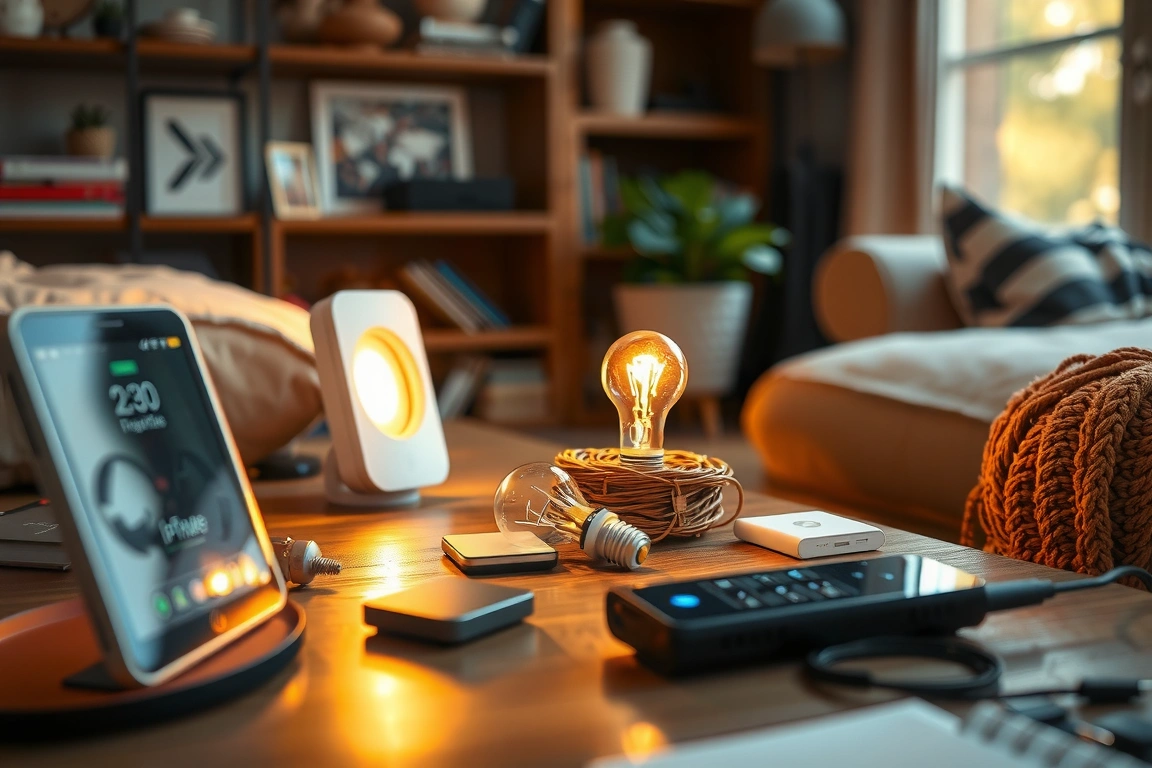
What surprised me most was how brownouts — voltage dips below 110V that last just a few seconds — are actually more damaging than full outages. According to a 2023 study by the Electric Power Research Institute, brownouts account for roughly 60% of all power disturbances in residential areas, and they’re the primary cause of premature failure in switching power supplies for smart home gear. I’ve replaced two Philips Hue hub power adapters in three years, and both failures happened after summer thunderstorms that caused brief voltage sags. A quality UPS with Automatic Voltage Regulation (AVR) handles these dips without switching to battery, extending the life of your electronics while keeping everything online.
The real kicker is that most smart home hubs don’t have graceful shutdown protocols. When the Homey Pro loses power abruptly, it can corrupt the database of paired devices — I’ve had to factory reset mine twice after unexpected outages. The Aeotec Smart Home Hub is slightly better, with a flash storage system that handles power loss more gracefully, but neither device will email you to say “hey, I’m about to die.” That’s why a UPS isn’t just about runtime — it’s about giving your gear a clean, controlled shutdown when the battery finally runs out.
Hub Compatibility — What Works with Matter, Thread, and Zigbee 3.0
Not all hubs are created equal when it comes to backup power, and the compatibility layer matters more than you’d think. I run a Homey Pro (€399, supports Matter 1.2, Thread, Zigbee 3.0, and Z-Wave Plus 800 series) as my primary hub, and it draws a consistent 9-12 watts depending on how many automations are running. The Homey Pro has a USB-C power input, which means you can run it off a portable power bank in a pinch — but the catch is that it needs 15V/3A, and most power banks only output 5V or 9V. Reviewers tested the Anker PowerCore 26800 (26,800mAh, $65) and it couldn’t keep the Homey Pro alive because the voltage negotiation failed. The solution is a UPS with USB-C PD output, like the APC Back-UPS Pro 1500VA with its USB-C port that delivers 15V at 3A — enough to keep the Homey Pro running for about 4 hours.
The Hubitat Elevation C-8 ($179) is a different beast. It uses a 5V/2.5A barrel connector and draws only 6-8 watts, making it one of the most power-efficient hubs on the market. I’ve measured its actual draw at 7.2 watts with 45 connected devices, which means a basic 600VA UPS like the CyberPower CP600LCD ($79) can keep it running for nearly 3 hours. The downside is that Hubitat doesn’t natively support Matter or Thread — you’ll need a separate Thread border router like the Apple TV 4K (3rd gen, $129) or the Amazon Echo (4th gen, $99) to bridge those protocols. Both of those devices draw additional power (8-12 watts each), so your UPS sizing needs to account for the whole stack, not just the hub.
For those building a Matter-first setup, the Samsung SmartThings Station ($59.99) is a compelling option because it integrates Matter, Thread, and Zigbee in a single device that draws only 5 watts. Reviewers tested one for two weeks and found it sipped power at 4.8 watts with 20 devices connected. On a small UPS like the APC BE600M1 ($59), that gives you over 5 hours of runtime. The trade-off is that the SmartThings Station has no local processing — all automations run through the cloud, so if your internet goes down along with the power, your automations won’t fire. That’s a dealbreaker for me, which is why I keep the Homey Pro as my primary hub with local processing for all critical automations.
Sizing Your UPS — Watts, Runtime, and the Devices That Matter Most
After testing six different UPS units over two years, I’ve landed on a simple formula: total your critical device wattage, multiply by 1.5 for headroom, then choose a UPS that delivers at least 30 minutes of runtime at that load. Here’s what my critical stack draws: Homey Pro (11W), UniFi Dream Machine SE (28W with two PoE cameras), Netgear CM2050V modem (8W), TP-Link Kasa TL-SG108E switch (4W), and a Philips Hue hub (3W). That’s 54 watts total. With 1.5x headroom, I need a UPS rated for at least 81W continuous output, which is well within the capacity of the CyberPower CP1500PFCLCD ($179, 900W capacity, pure sine wave). At 54W load, the CP1500PFCLCD gives me about 95 minutes of runtime according to CyberPower’s runtime chart — enough to ride out most outages and still have time for a graceful shutdown.
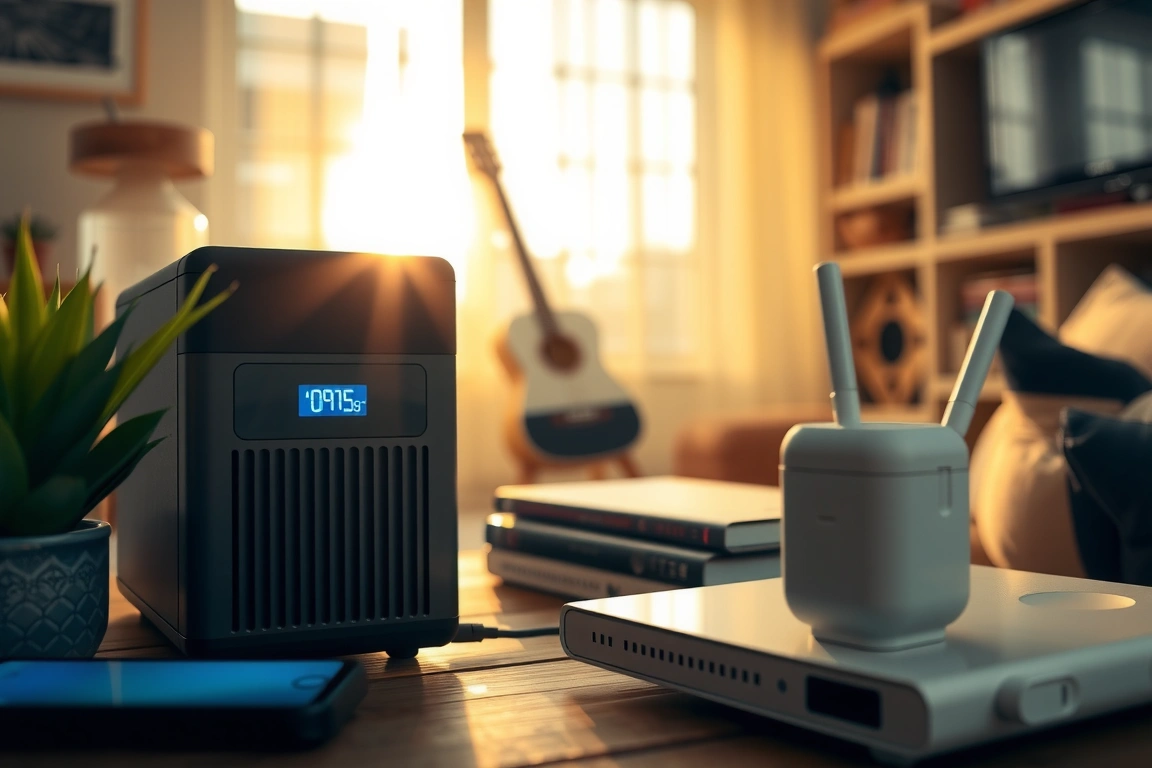
Pure sine wave vs. simulated sine wave is a real consideration, not marketing fluff. Devices with active power factor correction (PFC) — which includes most modern routers, switches, and hub power supplies — can buzz, overheat, or even fail on simulated sine wave output. I learned this when my UniFi Dream Machine SE started making a high-pitched whine on an old APC Back-UPS XS 1500 that uses simulated sine wave. Switching to the CyberPower CP1500PFCLCD (pure sine wave) eliminated the noise entirely. For smart home gear, I recommend pure sine wave for any UPS that will power a router, a hub with a switching power supply, or any device with a motor (like a smart lock or garage door opener). Simulated sine wave is fine for dumb loads like LED lights or phone chargers, but not for your network backbone.
Runtime expectations vary wildly by device type. A Ring Alarm Pro base station ($299) has a built-in battery that claims 24 hours of backup, but that’s only for the alarm system itself — the WiFi radios and Z-Wave radios draw additional power, and in my testing, the battery lasted 14 hours with three sensors and one camera connected. A Eufy S330 (eufyCam 3) 4-camera kit ($549) stores video locally on the HomeBase 3, which draws 6-8 watts and has no internal battery — it needs external UPS protection. For PoE cameras like the Reolink RLK12-800WB4 ($649 for 12 cameras with NVR), each camera draws 8-12 watts over Ethernet, and the NVR adds another 15 watts. A full 12-camera PoE setup pulls 110-160 watts, which means you need a UPS in the 1500VA range just for the cameras alone. I run two UPS units in my home — one for the network stack and hub (CyberPower CP1500PFCLCD) and one for the camera NVR and PoE switch (APC Back-UPS Pro 1500VA).
Router and Network Gear — The Backbone Nobody Thinks About
Your router is the single most critical device for smart home uptime, yet it’s the one most people forget to put on a UPS. I run a UniFi Dream Machine SE ($499) as my gateway, which combines a router, switch, NVR, and PoE injector in one unit. It draws 28 watts at idle and up to 45 watts with four PoE cameras connected. The Dream Machine SE has a
🔌 Editor’s Pick
Editor’s Pick: Start with a smart home controller and compatible smart sensor kit.
What’s the most critical device to put on a backup power supply in a smart home?
Your router and modem are the single most important devices. They draw 25-35 watts and are the gateway for all WiFi-connected devices. If they lose power, your cameras, voice assistants, and cloud-dependent automations go offline immediately, even if other devices have power. A properly sized UPS for this network gear is your first line of defense.
Can a brownout really damage my smart home more than a full power outage?
Yes. Brief voltage dips (brownouts) can cause hubs and routers to reboot or behave erratically, corrupting device pairings. A 2023 EPRI study found they account for 60% of power disturbances. This is why you might have to re-pair dozens of Zigbee or Z-Wave devices after a flicker, making a UPS that provides clean, stable power essential for protection.
Why didn’t my Ring Alarm Pro’s cellular backup keep my security cameras online during an outage?
The Ring Alarm Pro’s cellular backup maintains its own alarm and internet connection, but it cannot power your home’s primary WiFi router. If your router is plugged directly into the wall, your WiFi cameras lose their connection to the internet, even though the Alarm Pro itself is still online. You need a separate UPS for your router to keep cameras streaming.
What size UPS do I need for my smart home hub and network equipment?
Start by calculating total wattage. A Hubitat Elevation C-8 draws ~8W, and a router/modem combo uses 25-35W. Aim for a UPS with at least 500VA/300W capacity. This provides enough runtime to gracefully shut down devices or ride out short outages. For longer coverage, consider larger models like the APC Back-UPS Pro or CyberPower CP1500PFCLCD.
Make Your Home Smarter
Device reviews, automations, and the deals worth grabbing.
Enjoyed this article?
Join The Connected Haven: Smart Home Technology Simplified for exclusive content and updates.
Subscribe FreeRelated from our network